AI Workflows First. Agents Where It Matters
Building effective AI agents isn't about how complex you can make the system. It's about how simple you can keep it.
Building effective AI agents isn’t about how complex you can make the system — it’s about how simple you can keep it.
What I’m seeing across serious enterprise deployments is consistent: the “winners” aren’t betting on magic frameworks. They’re using simple, composable patterns and only adding autonomy when the data shows it improves outcomes.
Here’s the high-level breakdown for leaders navigating the agentic shift.
Know the difference: AI workflows vs agents
Most teams mix these up — and that’s where ROI gets fuzzy.
- Workflows: predefined code paths. Use these for predictable, repeatable tasks where consistency is king (think: automated refund processing).
- Agents: the model dynamically decides what to do next and which tools to use in a loop. Use these for open-ended problems where the path isn’t fixed (think: complex research, coding assistants).
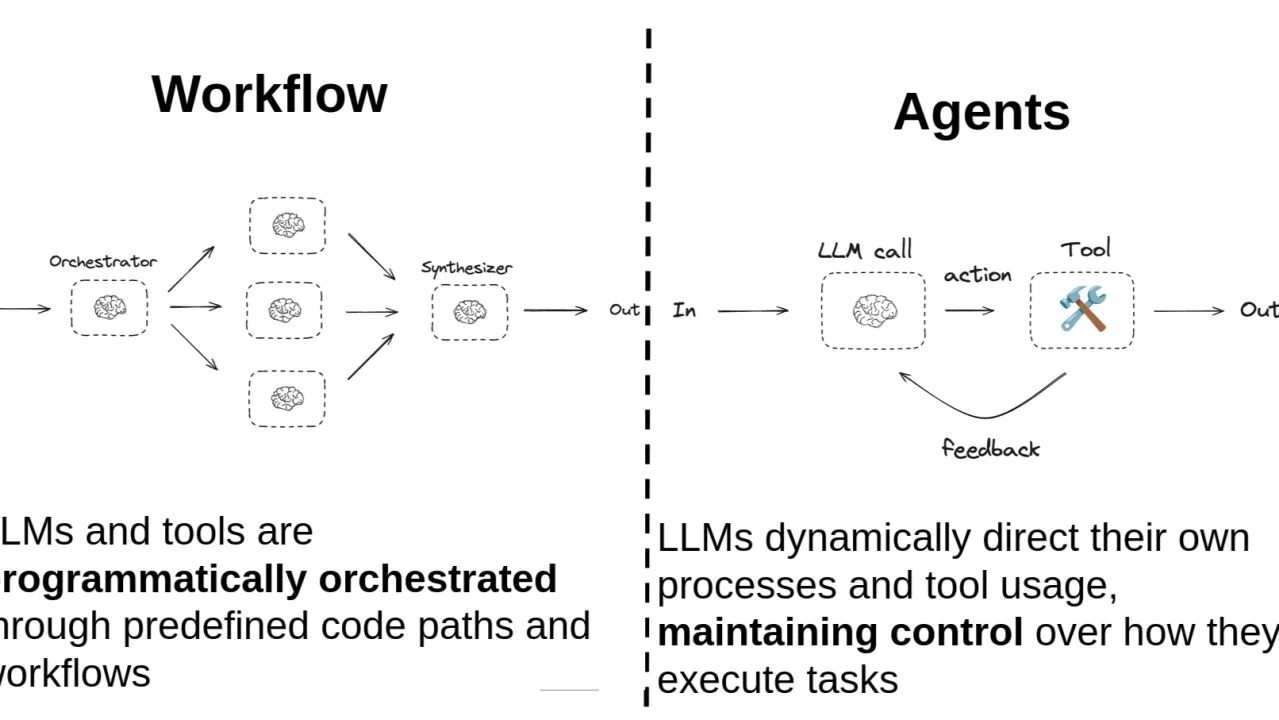
Strategy tip: Don’t build an agent if a workflow will do. Workflows are cheaper, faster, and easier to control. (This is also how you keep cost and latency sane.)
The five design patterns (think “management styles” for your AI)
These patterns show up repeatedly in real systems because they’re practical and scalable:
- Prompt chaining: break work into sequential steps
- Routing: classify and send to the right specialist
- Parallelization: multiple attempts/subtasks in parallel for speed/coverage
- Orchestrator → workers: a “manager” delegates to “workers”
- Evaluator → optimizer: create → critique → improve (ideal for high-stakes outputs)
The 3 golden rules for executive oversight
If your engineering team is building agents, I’d pressure-test these:
- Maintain simplicity: if you can’t explain the agent’s logic, it’s too complex.
- Prioritize transparency: the system should show planning/steps to create an audit trail for trust.
- Focus on the interface to tools (ACI): agents fail less because “the model is weak” and more because tools, permissions, and documentation are messy. Clean tool contracts = reliable automation.
One shift that will matter at board level: standardizing tool connectivity
As agents move from “demo” to “production,” how they connect to enterprise tools becomes strategic. That’s why standards like Model Context Protocol (MCP) and the new Agentic AI Foundation under the Linux Foundation are worth watching — they push interoperability and governance forward.
The bottom line
In the rush to “automate everything,” the winners won’t be the ones with the most autonomous agents. They’ll be the ones who build predictable systems that trade off autonomy for performance where it counts.
Start small. Measure often. Only add complexity when the data demands it.